

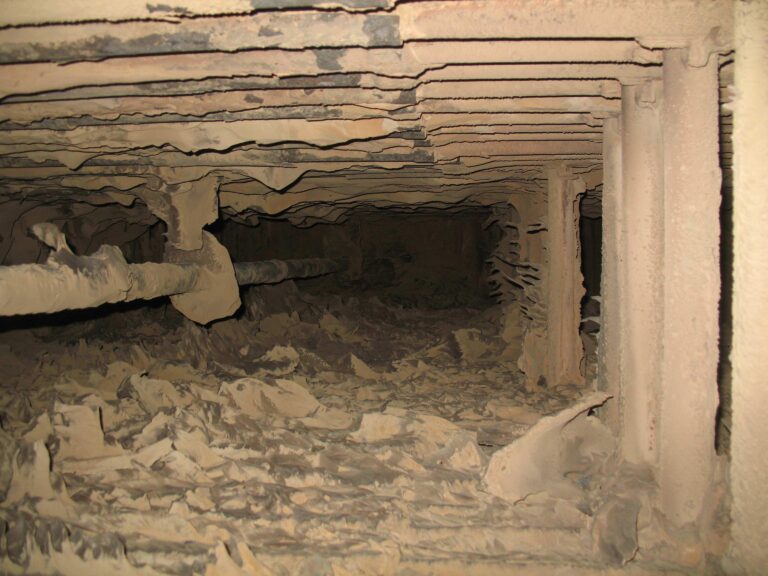
Rising flue gas temperatures in industrial boilers are almost always caused by deposit buildup on heat transfer surfaces. When ash, slag or other combustion residues accumulate on tube walls and furnace surfaces, they act as insulation, preventing heat from transferring into the water or steam circuit and forcing hot gases to exit the boiler at higher temperatures than intended. This article works through the underlying mechanisms, the industries most affected and the operational consequences of leaving the problem unaddressed.
What happens inside a boiler when flue gas temperatures rise?
When flue gas temperatures rise above design levels, it means the boiler is failing to extract the heat it was built to capture. Heat that should have transferred to the working fluid, water or steam, is instead leaving the system through the flue. The boiler is burning the same amount of fuel but producing less useful output, which is a direct measure of declining boiler efficiency.
The furnace alone accounts for roughly 50% of total heat transfer in a boiler. When that zone underperforms, the thermal deficit cascades downstream. Superheaters, reheaters and economisers all receive hotter-than-expected gas, which accelerates wear on those surfaces and compounds the original problem. The boiler’s control systems may compensate by increasing fuel input, which raises combustion temperatures further and worsens deposit formation in a self-reinforcing cycle.
What are the most common causes of rising flue gas temperatures?
The most common cause of rising flue gas temperatures in industrial boiler systems is fouling, the accumulation of ash, slag and other combustion byproducts on heat transfer surfaces. These deposits reduce the rate at which heat moves from the combustion gases into the boiler’s water or steam circuit, so gases exit the system hotter than intended.
Beyond fouling, several other factors contribute:
- Fuel quality variation: Fuels with higher ash content, moisture or alkali compounds produce more aggressive deposits. Switching fuel types without adjusting cleaning routines accelerates buildup.
- Incomplete combustion: Unburned carbon particles settle on surfaces and bond with ash, creating dense, insulating layers that are harder to remove than loose fly ash.
- Inadequate or poorly timed cleaning: Fixed cleaning schedules that do not reflect actual deposit conditions allow fouling to progress between cleaning cycles.
- Slagging in the furnace zone: At high temperatures, ash particles melt and fuse to furnace walls, forming clinker deposits with very low thermal conductivity.
- Air distribution problems: Uneven combustion air supply creates hot spots where deposits form faster and adhere more strongly.
In practice, most cases involve a combination of these factors rather than a single root cause.
How does boiler fouling reduce heat transfer efficiency?
Boiler fouling reduces heat transfer efficiency by placing a layer of thermally resistant material between the hot combustion gases and the metal surfaces designed to absorb that heat. Even a thin deposit layer has a thermal conductivity far lower than steel, so it acts as insulation and forces flue gases to carry more heat out of the boiler than they should.
The relationship between deposit thickness and efficiency loss is not linear: early layers of fouling cause a disproportionately large drop in heat transfer because they interrupt direct contact between the gas and the clean metal surface. As deposits thicken, the marginal impact per additional millimetre decreases, but the total efficiency penalty continues to grow.
Corrosion is a secondary consequence. Deposits trap moisture and corrosive compounds against the tube surface, accelerating metal degradation beneath the fouling layer. This means that fouling does not just reduce efficiency in the short term; it shortens the service life of heat transfer surfaces and increases the frequency and cost of maintenance interventions.
Why do waste-to-energy and biomass boilers see faster temperature increases?
Waste-to-energy and biomass boilers experience faster flue gas temperature increases because their fuel streams are chemically more aggressive and less consistent than coal or natural gas. Municipal solid waste and biomass feedstocks contain high concentrations of chlorine, alkali metals such as potassium and sodium and varying moisture levels, all of which promote rapid and adhesive deposit formation on furnace walls and heat transfer surfaces.
Chlorine in particular drives a corrosion mechanism where alkali chlorides condense on tube surfaces at relatively low temperatures, forming sticky deposits that capture fly ash particles and grow quickly. The resulting fouling layer is denser and more difficult to remove than the dry ash deposits typical of coal combustion.
Fuel variability adds another layer of complexity. Unlike coal, which arrives with relatively predictable combustion characteristics, waste and biomass feedstocks change composition with every delivery. A cleaning routine calibrated for one fuel mix may be inadequate when the composition shifts, allowing deposits to build faster than the cleaning system removes them. This inhomogeneous deposit distribution, where some areas foul heavily while others remain relatively clean, makes it harder to maintain consistent heat transfer across the boiler.
How can you tell if rising flue gas temperatures signal a serious problem?
Rising flue gas temperatures signal a serious problem when the increase is sustained, progressive or accompanied by other performance indicators moving in the wrong direction. A brief temperature spike during a load change or fuel transition is normal. A steady upward trend over days or weeks, or a step change that does not recover after a cleaning cycle, points to fouling that the current cleaning regime cannot control.
Key indicators to monitor alongside flue gas temperature include:
- Steam output relative to fuel input: If fuel consumption is rising to maintain the same steam production, heat transfer efficiency is declining.
- Pressure drop across heat exchanger sections: Increasing pressure drop suggests deposit accumulation is narrowing gas flow paths.
- Cleaning cycle response: If flue gas temperatures drop sharply after a cleaning cycle but return to elevated levels faster than before, deposit formation is accelerating.
- Clinker formation in the hopper area: Large clinker pieces falling from furnace walls indicate that slagging has reached a stage where structural and mechanical damage is a real risk.
- Tube surface temperature anomalies: Hot spots detected during inspection suggest that deposits are concentrating heat in specific areas, increasing corrosion risk.
Any combination of these signals alongside elevated flue gas temperatures warrants a systematic inspection rather than a wait-and-see approach.
What are the consequences of ignoring elevated flue gas temperatures?
Ignoring elevated flue gas temperatures leads to a predictable sequence of worsening outcomes: declining boiler efficiency, accelerating corrosion, unplanned shutdowns and ultimately costly emergency repairs or premature component replacement. Each stage is more expensive to address than the one before it.
The efficiency penalty is immediate and measurable. A boiler operating with significant fouling burns more fuel to produce the same output, increasing both operating costs and CO₂ emissions. In facilities under regulatory pressure to reduce emissions, this is not just a financial problem; it is a compliance risk.
Corrosion progresses silently beneath deposit layers. By the time it becomes visible during an inspection, tube wall thickness may already be compromised. Replacing heat exchanger tubes or furnace wall panels is a major intervention that requires extended downtime and significant capital expenditure.
The most severe consequence is an unplanned shutdown triggered by a tube failure or a large clinker fall damaging the hopper area. Unplanned downtime in a waste-to-energy or power generation facility carries costs that extend well beyond the repair itself: lost revenue, contractual penalties and the operational disruption of bringing a plant back online under pressure. Addressing rising flue gas temperatures early, through improved cleaning strategies and monitoring, is consistently less expensive than managing the consequences of inaction.
How Clyde Bergemann helps you control flue gas temperatures
Sustained high flue gas temperatures are a symptom of a cleaning and monitoring challenge that requires a systematic response. We support plant operators in waste-to-energy, biomass and power generation with on-load boiler cleaning solutions designed to address deposit buildup before it reaches the point of efficiency loss or unplanned shutdown.
- Targeted furnace cleaning: Our water-based and steam-based cleaning systems remove slagging and fouling from furnace walls and empty passes during operation, without requiring a shutdown.
- Demand-driven cleaning with SMART Clean: Rather than following a fixed schedule, our intelligent cleaning platform responds to actual deposit conditions, cleaning where and when it is needed, not on a timer.
- Coverage across all boiler zones: From the furnace through superheaters, reheaters, economisers and air preheaters, our systems address fouling at every stage of the flue gas path.
- More than 60 years of application experience: Our engineers bring deep knowledge of deposit behaviour across fuel types, including the aggressive fouling conditions typical of waste and biomass combustion.
- Service and spare parts support: We provide inspection, maintenance and rapid spare parts supply to keep cleaning systems operating reliably under the extreme conditions of industrial boiler environments.
If rising flue gas temperatures are affecting your plant’s performance, our Clyde Bergemann boiler efficiency solutions give you the tools to bring deposit buildup under control and restore heat transfer performance. To discuss your specific situation, get in touch with our team.
Related Articles
- What is sootblowing and why does it matter for boilers?
- How do sensor-based cleaning systems improve boiler performance?
- 4 ways smart boiler cleaning systems reduce maintenance workload
- What is demand-based boiler cleaning and how does it work?
- How is boiler fouling different in waste-to-energy plants compared to coal?