

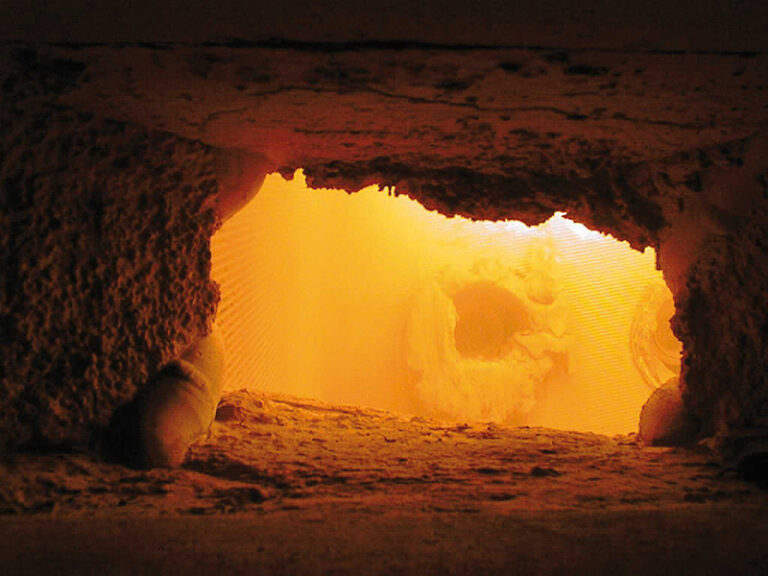
Sootblowing is the process of using a pressurised medium, typically steam, air or water, to remove ash, slag and other combustion deposits from the heat transfer surfaces inside a boiler while it continues to operate. Without it, those deposits accumulate layer by layer, steadily reducing the boiler’s ability to transfer heat and, left long enough, forcing an unplanned shutdown. The sections below answer the most common technical questions about sootblowing, from how it works mechanically to which industries rely on it most.
How does sootblowing actually clean a boiler?
Sootblowing cleans a boiler by directing a high-velocity jet of steam, compressed air or water at fouled heat transfer surfaces while the unit remains in service. The kinetic energy of the jet dislodges and disperses deposits before they can harden into thick, insulating layers. The loosened material falls into the ash collection system or is carried out with the flue gas stream.
The cleaning medium is delivered through a sootblower, a mechanical device that positions one or more nozzles at the correct angle and distance from the surface being cleaned. Depending on the design, the blowing tube may retract fully into the boiler wall between cycles, extend only partway into the flue gas path, or rotate in place without axial movement. Each approach is matched to the temperature zone, the geometry of the heating surface and the nature of the deposits present.
For furnace walls, water-based systems are often preferred because water carries significantly more thermal and kinetic energy per unit volume than steam, making it more effective against heavy slagging. In the superheater and reheater zones, where flue gas temperatures can exceed 1,000°C, steam or air is the standard medium because water injection at those temperatures requires careful engineering to avoid thermal shock to the tubes.
What types of deposits does sootblowing remove?
Sootblowing targets three main categories of deposit: fly ash, slagging and fouling. Fly ash consists of fine particulate matter carried by the flue gas that settles on tube surfaces. Slagging refers to molten or partially molten ash that sticks to furnace walls at high temperatures and solidifies. Fouling describes the bonded, often chemically complex deposits that form on convective heating surfaces at lower flue gas temperatures.
The composition and adhesion strength of these deposits vary considerably depending on fuel type. Biomass combustion, for example, tends to produce deposits rich in alkali compounds such as potassium and chlorine, which are particularly sticky and corrosive. Waste-to-energy plants deal with highly variable deposit chemistry because the fuel mix changes constantly. Coal-fired boilers typically produce silicate-based slags that behave differently again.
This variability is why no single sootblower design suits every application. Light, loosely bonded fly ash on economiser surfaces can be cleared by a rotating element sootblower operating at moderate pressure. Dense, vitrified slag on furnace walls may require a water cannon delivering a precisely shaped jet pattern to fracture and dislodge the material without damaging the membrane wall beneath it.
What happens to a boiler if sootblowing is neglected?
If sootblowing is neglected, deposits accumulate on heat transfer surfaces and act as thermal insulation, forcing the boiler to burn more fuel to produce the same steam output. Over time, this reduces boiler efficiency, raises flue gas exit temperatures and increases fuel consumption. In severe cases, deposit build-up leads to tube corrosion, clinker formation and unplanned shutdowns.
The efficiency loss is not gradual and linear. Deposits tend to grow unevenly, and once a critical thickness is reached in a particular zone, heat transfer in that area drops sharply. The boiler control system compensates by increasing firing rate, which raises temperatures elsewhere and accelerates wear on other components.
Clinker formations in the furnace present a specific mechanical hazard. When a large mass of solidified slag detaches from the furnace wall, it falls into the hopper area below. Depending on its size and the design of the hopper, this can cause structural damage or block the ash removal system entirely. Corrosion is a related risk: deposits that contain chlorine or sulphur compounds create aggressive local chemistry at the tube surface, accelerating metal loss even when the deposit itself appears stable.
From an operational standpoint, the cost of neglecting boiler cleaning compounds quickly. Reduced efficiency means higher fuel spend every hour the unit runs. An unplanned shutdown for deposit removal or tube repair typically costs far more than a well-maintained cleaning programme, both in lost generation and in emergency maintenance labour.
What’s the difference between online and offline boiler cleaning?
Online boiler cleaning, also called on-load cleaning, takes place while the boiler is operating at full or partial load. Offline cleaning requires the unit to be shut down, cooled and taken out of service. Sootblowing is an online cleaning method, which is its primary operational advantage: it maintains heat transfer efficiency continuously without interrupting power or steam production.
Offline cleaning methods, such as water washing or manual deposit removal, are typically reserved for scheduled maintenance outages. They can address deposits that have hardened beyond what online systems can remove, and they allow inspection of surfaces that are inaccessible during operation. However, every hour a boiler spends offline represents lost output and, in many facilities, a direct financial cost.
The practical implication is that online and offline cleaning are complementary rather than competing approaches. A well-designed sootblowing programme keeps deposits manageable between outages, which means offline cleaning during planned maintenance is faster, less intensive and less likely to reveal damage caused by unchecked fouling. Facilities that rely solely on offline cleaning tend to find that deposit build-up between outages is heavier and more damaging than it would be with continuous on-load maintenance.
How often should sootblowing cycles run?
The optimal sootblowing frequency depends on fuel type, boiler load, deposit formation rate and the specific zone being cleaned. There is no universal fixed interval. Running sootblowers too infrequently allows deposits to harden and become harder to remove. Running them too frequently wastes cleaning medium, causes unnecessary thermal cycling on tube surfaces and can erode tube walls over time.
Traditional approaches used fixed time-based schedules, cycling each sootblower at set intervals regardless of actual deposit conditions. This is operationally simple but inherently inefficient: it cleans areas that may not need it while potentially under-cleaning zones where deposits form faster due to local combustion conditions.
Demand-driven cleaning is a more effective alternative. In this approach, sensors and diagnostic systems monitor deposit build-up in real time, and cleaning cycles are triggered based on actual fouling levels rather than a clock. This means each sootblower operates only when and where it is needed, reducing steam or water consumption, extending the service life of the blowing tubes and nozzles and avoiding unnecessary thermal stress on heat transfer surfaces.
Fuel flexibility makes this particularly relevant in 2026. Plants that switch between fuel types, or that co-fire biomass with waste or coal, experience deposit formation rates that change with every fuel mix adjustment. A fixed cleaning schedule calibrated for one fuel will be wrong for another. Adaptive, demand-driven cleaning handles this variability automatically.
Which boiler types and industries use sootblowing systems?
Sootblowing systems are used in any boiler or heat recovery unit where combustion gases carry particulate matter that deposits on heat transfer surfaces. This covers power generation boilers fired by coal, gas or oil; waste-to-energy plants; biomass-fired boilers; industrial process boilers in the chemical, cement and mineral industries; and waste heat recovery units on marine vessels.
Each industry presents distinct challenges. Waste-to-energy plants deal with highly variable fuel chemistry and deposit compositions that change with every load of municipal solid waste. Biomass plants contend with alkali-rich deposits that are both sticky and corrosive. Coal-fired power stations face slagging in the furnace and fouling in the convective pass, with deposit characteristics that vary by coal grade. Marine waste heat recovery units operate in a space-constrained environment where sootblowers must be compact and reliable with minimal maintenance access.
The boiler zones that require cleaning also vary by application. Furnace walls, superheater and reheater tube banks, economisers, air preheaters, gas-gas heaters and catalytic absorbers each have different temperature profiles, tube geometries and deposit types. A complete sootblowing installation typically combines several different sootblower types, each selected for the specific conditions in its zone, rather than applying a single product across the entire boiler.
How Clyde Bergemann supports your boiler cleaning strategy
We work with plant operators across power generation, waste-to-energy, biomass and industrial processing to design and implement on-load boiler cleaning systems that match the actual conditions in each facility. Our approach is based on more than 60 years of experience in boiler cleaning, and we apply that knowledge to every project, from initial engineering through to long-term service support.
- Application-specific system design: We select and configure sootblowers for each boiler zone, matching the cleaning medium, travel distance and nozzle geometry to the deposit type and flue gas temperature present.
- Demand-driven cleaning technology: Our SMART Clean philosophy uses diagnostics and sensor data to trigger cleaning based on actual deposit conditions, reducing cleaning medium consumption and thermal stress on tube surfaces.
- Full product range across all boiler zones: From furnace wall blowers and water cannons to retractable sootblowers for superheater areas and rotating element sootblowers for economisers, we cover every application within a boiler.
- Fuel flexibility support: For plants operating with variable or mixed fuels, we engineer cleaning systems that adapt to changing deposit formation rates rather than relying on fixed schedules.
- Service and spare parts: We provide global service support, inspection, maintenance and training to keep systems operating reliably under the extreme conditions typical of industrial boilers.
If you want to understand which cleaning approach fits your specific boiler configuration, our team is available for a technical consultation. You can also explore the full range of Clyde Bergemann boiler efficiency solutions to see how individual products address the challenges described in this article.
Related Articles
- Can you retrofit an on-load cleaning system to an existing boiler?
- When does it make sense to upgrade from sootblowers to an online cleaning system?
- Why is continuous boiler cleaning critical in waste-to-energy plants?
- What is slagging in industrial boilers and how is it different from fouling?
- What is the convection pass in a boiler and why does it foul first?