

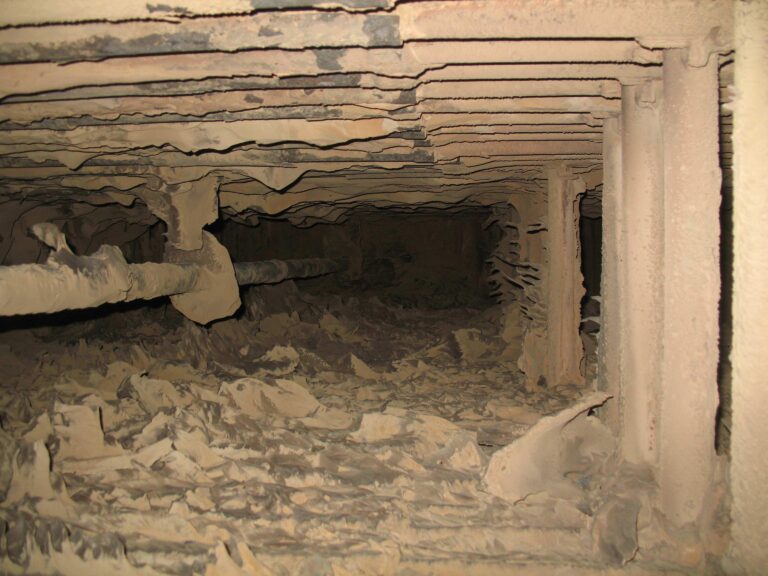
Biomass boilers are significantly more prone to fouling than conventional coal-fired systems because of the chemical composition of biomass fuels. Biomass contains higher concentrations of alkali metals, chlorine and moisture, which react at combustion temperatures to form sticky, corrosive deposits on heat transfer surfaces far more aggressively than the ash produced by coal combustion. The sections below break down the specific mechanisms behind this problem and what plant operators can do about it.
What types of deposits form inside biomass boilers?
Biomass boilers are affected by two primary deposit types: slagging and fouling. Slagging refers to molten or partially molten ash deposits that form on furnace walls and radiant heat transfer surfaces exposed to the highest temperatures. Fouling describes the accumulation of ash on convective surfaces such as superheaters, reheaters and economisers, where flue gas temperatures are lower but deposit build-up is still significant.
In practice, biomass combustion produces a more complex mix of deposit types than coal. Alkali-rich ash from fuels like straw, agricultural residues and certain wood types forms low-melting-point compounds that bond strongly to tube surfaces. Chlorine in the fuel accelerates this process by forming alkali chlorides that condense on cooler surfaces and then react further to create dense, layered deposits. These deposits are often inhomogeneous in distribution, meaning they build up unevenly across the boiler, making systematic cleaning more difficult.
Clinker formations are another concern specific to high-temperature zones. When slagging deposits grow large enough, they detach and fall, potentially damaging the hopper area at the base of the furnace. Left unmanaged, these deposit types reduce heat transfer efficiency, increase corrosion rates and raise the risk of unplanned shutdowns.
Why do biomass fuels produce more aggressive fouling than coal?
Biomass fuels produce more aggressive fouling than coal primarily because of their higher alkali metal content and the presence of chlorine. Potassium and sodium, which are abundant in many biomass feedstocks, form low-melting-point silicates and sulphates that become sticky at typical boiler operating temperatures. Coal ash, by contrast, tends to form harder, less adhesive deposits that are easier to remove.
Chlorine plays a particularly damaging role. During combustion, chlorine combines with potassium to form potassium chloride, which deposits on superheater tubes and then reacts with sulphur dioxide in the flue gas to release hydrochloric acid. This acid attacks the tube surface directly, causing accelerated corrosion beneath the deposit layer. The combination of chemical bonding and corrosive attack makes biomass deposits far harder to manage than conventional coal ash.
Phosphorus, present in fuels derived from animal waste or certain agricultural residues, adds another layer of complexity by forming phosphate compounds that contribute to deposit stickiness. The net result is that biomass boiler fouling is not just a mechanical problem of ash accumulation but a chemical problem that degrades the boiler structure itself over time.
How does fuel variability make biomass fouling harder to control?
Fuel variability makes biomass fouling harder to control because the chemical composition of biomass feedstocks changes significantly depending on the source, season and supply chain. A boiler optimised for wood pellets will behave very differently when switched to agricultural straw, demolition wood or a mixed fuel blend. Each fuel type produces a different ash chemistry, deposit morphology and fouling rate.
This variability is a practical challenge for maintenance managers who operate plants that accept multiple fuel types or whose fuel supply quality fluctuates. When alkali content rises unexpectedly, deposit formation accelerates faster than a fixed cleaning schedule can address. When moisture content increases, combustion temperatures drop, which changes where deposits form within the boiler and how quickly they accumulate.
Plants that co-fire biomass with waste or other secondary fuels face additional complexity. Waste streams introduce contaminants such as heavy metals, plastics and chlorinated compounds that interact with biomass ash in unpredictable ways. Managing fouling under these conditions requires cleaning systems that can respond to the actual deposit situation rather than following a predetermined schedule regardless of what is happening inside the boiler.
What role does combustion temperature play in deposit formation?
Combustion temperature directly determines whether ash particles arrive at heat transfer surfaces in a molten, semi-molten or solid state. When furnace temperatures exceed the ash fusion temperature of the specific biomass fuel being burned, ash melts and adheres strongly to surfaces on contact. Lower temperatures produce drier, more friable deposits that are easier to remove but can still accumulate rapidly in convective zones.
The furnace accounts for approximately 50% of total heat transfer in a boiler, which makes temperature management in this zone particularly important. Biomass fuels often have lower ash fusion temperatures than coal, meaning slagging can occur at operating temperatures that would be safe for a coal-fired system. This is one reason why a boiler designed for coal cannot simply be converted to biomass without addressing the fouling risk.
Temperature gradients across the boiler also matter. In the superheater and reheater zones, flue gas has cooled enough that alkali compounds condense from vapour onto tube surfaces, forming the initial sticky layer that then captures further ash particles. In the economiser and air preheater zones, temperatures are lower still, and deposits tend to be drier but can still restrict flue gas flow and reduce heat transfer efficiency significantly over time.
How do fouling deposits reduce boiler efficiency over time?
Fouling deposits reduce boiler efficiency by acting as thermal insulation on heat transfer surfaces. Even a thin layer of ash significantly increases the resistance to heat flow between the hot flue gas and the water or steam inside the tubes. As deposits thicken, the boiler must burn more fuel to achieve the same steam output, increasing fuel consumption and operating costs.
The efficiency loss is not linear. Early-stage deposits cause a measurable but manageable reduction in heat transfer. As deposits build up and harden, particularly in high-temperature zones where they sinter or fuse, the rate of efficiency loss accelerates. At the same time, restricted flue gas flow increases pressure drop across the boiler, which adds load to fans and further reduces overall plant efficiency.
Corrosion beneath deposits compounds the problem. When alkali chlorides and sulphates react with tube surfaces, they weaken the metal over time, reducing tube wall thickness and increasing the risk of tube failure. A tube failure forces an unplanned shutdown, which is the outcome maintenance managers are most focused on avoiding. The financial impact of an unplanned outage, including lost generation revenue and emergency repair costs, far exceeds the cost of proactive deposit management.
What cleaning strategies are most effective for biomass boiler fouling?
The most effective cleaning strategies for biomass boiler fouling combine the right cleaning technology for each boiler zone with demand-driven control that responds to actual deposit conditions rather than a fixed schedule. No single cleaning method addresses all deposit types across all zones, so effective fouling management requires a coordinated approach across the furnace, superheater, reheater and economiser.
Furnace cleaning
In the furnace, where slagging deposits are heaviest and most adhesive, water-based cleaning systems deliver the most effective results. Water jets can remove heavy slagging that steam or air cannot dislodge, and advanced systems with precise positioning drives can create targeted cleaning patterns across furnace walls to address uneven deposit distribution. Wall blowers using steam remain a well-established option for lighter slagging on membrane wall surfaces.
Convective zone cleaning
In the superheater, reheater and economiser zones, retractable and part-retractable sootblowers are the standard approach. These systems extend a lance into the flue gas path and deliver a cleaning medium, typically steam or air, directly onto fouled surfaces. For zones with particularly heavy or localised fouling, oscillating sootblowers provide targeted cleaning of specific boiler segments. In areas with loose deposits and varying fuel conditions, rapping systems offer an effective alternative that requires neither air nor steam as a cleaning medium, which reduces maintenance costs.
Demand-driven cleaning control
Across all zones, the shift from fixed-schedule cleaning to demand-driven cleaning is one of the most impactful changes a plant can make. Fixed schedules clean surfaces whether they need it or not, wasting cleaning medium and causing unnecessary thermal stress on tubes. Demand-driven systems use sensor data and boiler diagnostics to identify where deposits are forming and trigger cleaning only when and where it is needed. This approach is particularly valuable in biomass plants where fuel variability means deposit formation rates change constantly.
How Clyde Bergemann supports biomass boiler fouling management
Managing fouling in biomass boilers requires more than a single product. It requires a cleaning strategy that covers every zone of the boiler and adapts to the fuel conditions your plant actually operates under. That is exactly what we design and deliver.
- We offer on-load cleaning systems for every boiler zone, from furnace wall blowers and water cannons to retractable sootblowers for superheater and reheater areas and rapping systems for economisers with loose deposits
- Our demand-driven SMART Clean approach means cleaning is triggered by actual deposit conditions, not a fixed schedule, which reduces unnecessary cleaning cycles and extends equipment service life
- We support plants operating with variable fuel mixtures and fluctuating fuel quality, designing cleaning strategies that remain effective even as combustion conditions change
- Our controls and diagnostics technology integrates with on-load cleaning equipment to give your team clear visibility of deposit build-up and cleaning performance across the entire boiler
- With more than 60 years of experience in boiler cleaning and references across biomass and waste-to-energy plants in Europe and beyond, we bring proven solutions to the specific challenges biomass combustion creates
If you are dealing with persistent fouling, rising fuel consumption or unplanned shutdowns linked to deposit build-up, our team can help you assess your current cleaning setup and identify where improvements will have the greatest impact. Explore our Clyde Bergemann boiler efficiency solutions or get in touch to discuss your plant’s specific situation.