

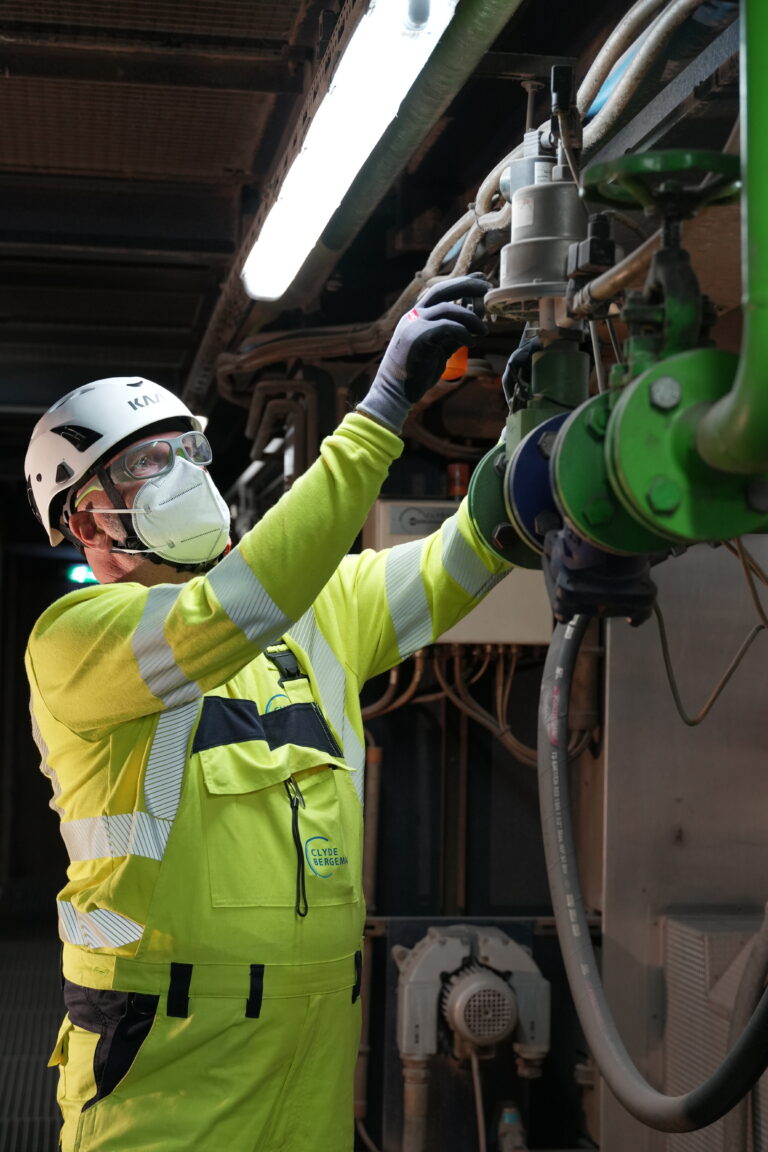
On-load boiler cleaning and offline boiler cleaning differ in one fundamental way: on-load cleaning happens while the boiler continues to operate at full capacity, whereas offline cleaning requires a planned shutdown. For plants in waste-to-energy, biomass and power generation, this distinction has a direct impact on availability, output and maintenance costs. The sections below address the most common questions about both methods and when each one applies.
How does on-load boiler cleaning work while the boiler stays online?
On-load boiler cleaning removes deposits from heat transfer surfaces while the boiler remains in full operation. Cleaning devices such as sootblowers, water cannons and rapping systems are installed at fixed positions throughout the boiler and activated during normal running conditions, without interrupting steam production or reducing load.
The principle behind on-load cleaning is continuous deposit management. Fouling builds up on furnace walls, superheaters, economisers and air preheaters as a natural consequence of combustion. Left unaddressed, these deposits act as insulation, reducing heat transfer and forcing the boiler to consume more fuel to maintain output. On-load systems intervene before deposits reach a thickness that causes measurable efficiency loss.
Different zones of the boiler require different cleaning approaches. In the furnace, where temperatures are highest and slagging is most aggressive, water-based systems such as wall blowers and shower-clean systems are used to dislodge heavy deposits from membrane walls. In the superheater and reheater zones, retractable and oscillating sootblowers use steam or air as the cleaning medium. Economisers and air preheaters are typically served by rake sootblowers or rotating element sootblowers.
Modern on-load cleaning goes beyond fixed cleaning schedules. Demand-driven systems use sensor data and boiler diagnostics to determine when and where cleaning is actually needed, rather than running on a timer. This approach reduces unnecessary cleaning cycles, lowers wear on components and avoids the thermal stress that comes from overcleaning.
What happens during offline boiler cleaning?
Offline boiler cleaning takes place during a planned shutdown when the boiler is taken out of service, cooled down and made safe for personnel to enter. Maintenance teams then access internal surfaces manually or with specialist equipment to remove deposits that have hardened or accumulated beyond what on-load systems can address.
The process typically involves high-pressure water jetting, mechanical chipping or chemical treatment of heavily fouled surfaces. Inspection teams assess the condition of heat transfer surfaces, refractory linings and tube banks, and any damaged components are repaired or replaced during the same outage window.
Offline cleaning is thorough by nature. Because the boiler is cold and depressurised, technicians can reach areas that are inaccessible during operation and apply more aggressive cleaning methods without risk to the plant or personnel. However, the cost of an offline clean extends well beyond the cleaning activity itself. Every hour the boiler is offline represents lost generation capacity, and in waste-to-energy plants, it may also mean diverting waste streams to alternative disposal routes.
Planned outages are typically scheduled annually or at intervals defined by the operator’s maintenance programme and regulatory requirements. The duration depends on the size of the boiler, the severity of fouling and the scope of any concurrent maintenance work.
What are the main differences between on-load and offline cleaning?
The main differences between on-load and offline boiler cleaning are operational continuity, cleaning intensity and cost structure. On-load cleaning maintains boiler availability and manages deposits progressively, while offline cleaning is more intensive but requires a full shutdown and carries significant downtime costs.
The table below summarises the key distinctions:
- Plant availability: On-load cleaning keeps the boiler running; offline cleaning requires a planned outage lasting days or weeks.
- Cleaning intensity: Offline cleaning can address hardened, thick deposits that on-load systems cannot fully remove; on-load cleaning prevents deposits from reaching that stage.
- Cost profile: On-load systems involve capital investment and ongoing operating costs but avoid lost revenue from downtime; offline cleaning concentrates costs into outage windows but requires no permanently installed equipment beyond access provisions.
- Frequency: On-load cleaning operates continuously or on demand; offline cleaning is periodic, typically once or twice per year.
- Personnel access: Offline cleaning requires personnel to enter the boiler; on-load cleaning is fully automated and remote.
- Deposit management: On-load cleaning is preventive; offline cleaning is corrective.
In practice, the two methods are not alternatives but complements. Plants that operate effective on-load cleaning systems still require periodic offline maintenance, but the scope and duration of those outages are typically reduced because deposits have been kept under control throughout the operating period.
When does offline cleaning become unavoidable despite on-load systems?
Offline cleaning becomes unavoidable when deposits have hardened to a point where on-load systems can no longer remove them effectively, when regulatory inspection requirements mandate internal access or when other maintenance activities require the boiler to be taken offline anyway.
Several situations make an offline clean necessary regardless of how well on-load systems perform:
- Clinker formation: Large clinker masses that have fused to furnace walls or fallen into the hopper area cannot be safely dislodged during operation and must be removed manually during a shutdown.
- Tube inspection and repair: Regulatory frameworks in most countries require periodic internal inspection of pressure parts. These inspections can only be carried out when the boiler is cold and depressurised.
- Corrosion damage: If deposits have caused localised corrosion on tube surfaces, the affected tubes must be assessed and potentially replaced during an outage.
- Refractory maintenance: Furnace refractory linings degrade over time and require repair or replacement that is only possible offline.
- Fuel changes: Switching to a new fuel type with different ash chemistry can produce deposit compositions that existing on-load systems were not designed to handle, requiring a corrective offline clean before the system is reconfigured.
The goal of a well-designed on-load cleaning programme is not to eliminate offline maintenance entirely but to reduce its frequency, shorten outage duration and ensure that when the boiler does come offline, the maintenance team is dealing with manageable fouling rather than severe accumulation.
Which cleaning method is better for waste-to-energy and biomass plants?
For waste-to-energy and biomass plants, on-load boiler cleaning is the more effective primary strategy because these fuels produce highly variable and aggressive deposit profiles that require continuous management. Offline cleaning alone cannot prevent the efficiency losses and corrosion damage that result from uncontrolled fouling between outages.
Waste and biomass combustion present specific challenges that make on-load cleaning particularly relevant. Both fuel types produce ash with high alkali and chlorine content, which leads to sticky, corrosive deposits that bond strongly to heat transfer surfaces. The composition of the fuel also varies significantly, meaning deposit behaviour changes from day to day and even hour to hour. A fixed cleaning schedule designed for one fuel condition will be either insufficient or excessive under different conditions.
Demand-driven on-load cleaning addresses this directly. By monitoring actual deposit conditions using flux sensors and boiler diagnostics, the cleaning system responds to what is happening in the boiler rather than following a predetermined programme. This is particularly valuable in waste-to-energy plants, where operators have limited control over fuel composition and must adapt cleaning intensity to match changing combustion conditions.
Biomass plants face similar challenges, particularly in the furnace and empty passes where deposit build-up is uneven and influenced by fuel moisture content, particle size and combustion temperature. Water-based cleaning systems are well suited to these environments because they can remove heavier fouling that steam-based sootblowers cannot address.
Offline cleaning remains a necessary part of the maintenance programme for both plant types, but its role is corrective and periodic rather than primary. Plants that invest in effective on-load cleaning typically see longer intervals between major outages, reduced scope of work during those outages and more stable boiler efficiency across the full operating year.
How Clyde Bergemann supports your boiler cleaning strategy
We have been developing on-load boiler cleaning solutions for close to 100 years, with specific expertise in the deposit challenges that waste-to-energy and biomass plants face. Our approach combines installed cleaning equipment with diagnostics and demand-driven control technology to give your plant a cleaning strategy that adapts to actual operating conditions rather than fixed assumptions.
Here is what we offer for plants looking to improve their boiler cleaning performance:
- On-load cleaning systems for every boiler zone: From SMART Cannons and Shower-Clean Systems for furnace walls to retractable and oscillating sootblowers for superheaters and economisers, we supply equipment matched to the specific deposit conditions in each part of your boiler.
- Demand-driven SMART Clean technology: Our SMART Clean approach uses real-time deposit data to determine when, where and how intensively to clean, reducing unnecessary cleaning cycles and extending component life.
- Controls and diagnostics integration: Our digital boiler controls allow cleaning to be managed and monitored from the control room, with targeted activation of individual cleaning devices based on actual fouling conditions.
- Spare parts and service support: We provide spare parts, maintenance support and on-site service to keep your cleaning systems operating reliably under the demanding conditions of waste-to-energy and biomass combustion.
- Training and consultation: Our engineers bring more than 60 years of operational experience in power plant boiler cleaning and can help you build the technical and economic case for upgrading or replacing existing systems.
If you want to understand how our Clyde Bergemann boiler efficiency solutions apply to your specific plant and fuel type, we are happy to discuss your situation in detail. Get in touch and one of our engineers will follow up with you directly.
Related Articles
- Can on-load cleaning systems reduce corrosion in waste boilers?
- Why legacy boiler cleaning solutions underperform in waste-to-energy plants
- How do you know if your current boiler cleaning system is underperforming?
- How is boiler fouling different in waste-to-energy plants compared to coal?
- How much efficiency does a fouled boiler lose?