

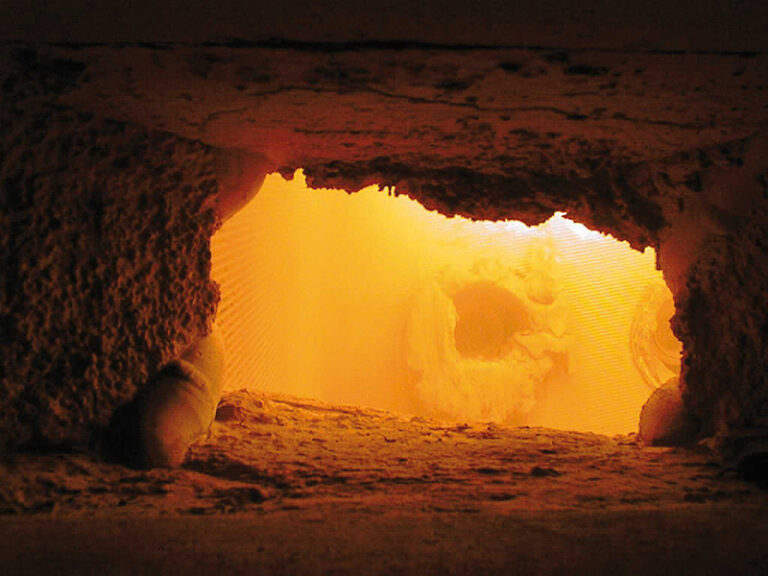
Deposits form on boiler heat exchange surfaces when ash particles, unburned carbon and condensed chemical compounds carried in the flue gas settle on tube walls and membrane surfaces. The process begins the moment combustion gases contact cooler surfaces, and it accelerates whenever fuel composition, gas temperature or flow velocity shifts. Understanding how deposits build up is the first step toward controlling them and protecting long-term boiler efficiency.
What types of deposits form on boiler heat exchange surfaces?
Boiler heat exchange surfaces accumulate two broad categories of deposits: loose, powdery fly ash that settles under gravity and low gas velocities, and hard, fused slag or clinker that bonds chemically to tube surfaces at high temperatures. The type that dominates in any given zone depends on the local flue gas temperature, the mineral content of the fuel and the surface temperature of the tubes themselves.
In the furnace and radiant sections, where temperatures are highest, molten or partially molten ash particles strike the membrane walls and solidify on contact. This produces slagging: a dense, glassy layer that insulates the tube surface and is difficult to dislodge mechanically. Further downstream, in the convective passes, superheater and economiser sections, temperatures drop and a different mechanism takes over. Fine ash particles adhere through van der Waals forces and sintering, forming what is commonly called fouling. Fouling deposits are initially softer but harden progressively as heat drives out moisture and promotes chemical bonding between particles.
A third deposit type, relevant particularly in waste-to-energy and biomass applications, involves condensed alkali compounds. Potassium and sodium chlorides vaporise in the flame zone and then condense on cooler tube surfaces, forming a sticky, corrosive sublayer that acts as a glue for incoming ash particles. This sublayer is one of the main reasons deposits in these fuel types are both more aggressive and more corrosive than those found in conventional coal-fired boilers.
How does ash behaviour drive deposit formation?
Ash behaviour drives deposit formation through three linked mechanisms: particle stickiness at elevated temperatures, the mineral composition of the fuel and the physical trajectory of particles through the gas stream. When ash particles reach or exceed their softening temperature, they become adhesive on contact with any surface, and the deposit grows rapidly from that point.
The mineral content of the fuel determines the softening and melting temperatures of the ash. Fuels rich in alkali metals such as potassium and sodium produce ash that softens at relatively low temperatures, meaning stickiness occurs earlier in the gas path and across a wider range of boiler zones. Fuels with higher calcium or silica content tend to produce ash with higher melting points, which behaves differently and is generally less prone to hard slagging, though it can still form dense fouling layers.
Particle size also matters. Coarser particles carry more momentum and are more likely to impact tube surfaces directly, particularly on the leading edges of tube banks. Finer particles follow the gas flow more closely but are more susceptible to thermophoresis, the phenomenon where a temperature gradient between the hot gas and the cooler tube surface draws particles toward the wall. This is why even in zones where direct impaction is low, a thin but persistent deposit layer still develops over time.
Why do waste-to-energy and biomass boilers foul faster than coal-fired units?
Waste-to-energy and biomass boilers foul faster than coal-fired units primarily because their fuels contain significantly higher concentrations of alkali metals, chlorine and moisture. These elements lower ash melting points, promote the formation of sticky condensed compounds and accelerate the chemical bonding of deposits to tube surfaces. The result is faster deposit growth rates and harder, more corrosive layers that are more difficult to remove.
Municipal solid waste is particularly challenging because its composition varies continuously. A shift in the waste stream, more plastics one week, more organic material the next, changes the chlorine content and the calorific value of the fuel simultaneously. This variability means the boiler rarely operates under stable combustion conditions, and the deposit characteristics change accordingly. Operators cannot rely on a fixed cleaning schedule because the fouling rate itself is not fixed.
Biomass fuels, especially agricultural residues such as straw or energy crops, are high in potassium and chlorine. Potassium chloride condenses on superheater tubes at temperatures that are well within normal operating ranges, forming the corrosive sublayer described earlier. This sublayer not only anchors further ash deposits but also attacks the tube material directly, meaning that uncontrolled fouling in biomass boilers carries a higher corrosion risk than in coal-fired equivalents. The furnace alone accounts for approximately 50% of total heat transfer in a boiler, so heavy deposits in this zone have an outsized impact on overall plant performance.
What role do flue gas temperature and flow patterns play?
Flue gas temperature and flow patterns determine where deposits form, how quickly they grow and how hard they become. High gas temperatures promote slagging by keeping ash particles in a molten or semi-molten state. Irregular flow patterns create zones of low velocity where particles drop out of suspension and accumulate, and zones of high turbulence where particles are driven into tube surfaces by impaction.
Temperature gradients and deposit hardness
The temperature difference between the flue gas and the tube surface governs the rate at which condensable compounds deposit and how rapidly a soft fouling layer sinters into a hard crust. Where this gradient is steep, condensation is fast and the initial deposit layer forms quickly. As the deposit thickens, it acts as an insulator, raising the surface temperature of the outer deposit layer and promoting further sintering. This self-reinforcing cycle means that a deposit which starts as loose ash can become a dense, fused layer within days if left uncleaned.
Flow velocity and deposit distribution
Low gas velocity zones, such as the corners of furnace chambers or the wake regions behind tube banks, allow particles to settle under gravity and accumulate without being re-entrained. High-velocity zones, particularly at tube bends and at the leading edges of superheater platens, experience direct particle impaction. The deposits that form in these two environments have different structures: gravity-settled deposits are often loose and layered, while impaction deposits are denser and more mechanically bonded to the surface. This inhomogeneous distribution across the boiler is one reason why a single cleaning approach applied uniformly across all zones is rarely optimal.
How do deposits reduce boiler efficiency over time?
Deposits reduce boiler efficiency by acting as thermal insulation on heat exchange surfaces. As the deposit layer thickens, it increases the resistance to heat transfer between the hot flue gas and the water or steam inside the tubes. The boiler must burn more fuel to achieve the same steam output, fuel consumption rises and CO2 emissions increase proportionally.
The efficiency loss is not linear. In the early stages of deposit formation, the impact on heat transfer is modest. But as the layer grows and sinters, the insulating effect compounds. A relatively thin but dense slag layer can reduce local heat transfer by a significant margin, forcing the flue gas to exit the boiler at a higher temperature than designed. This elevated exit temperature is a direct measure of heat that was not recovered, and it shows up immediately in efficiency monitoring data.
Beyond heat transfer losses, heavy deposits create secondary problems. Clinker formations, large fused masses of slag that break away from furnace walls, can damage the hopper area and cause unplanned shutdowns. Corrosion under deposits accelerates tube wall thinning, shortening the service life of components that operate under extreme thermal and pressure stress. Each of these effects compounds the original efficiency loss with additional maintenance costs and reduced plant availability.
What determines how difficult a deposit is to remove?
The difficulty of removing a deposit depends on its chemical composition, its physical structure and how long it has been in contact with the tube surface. Hard, fused slag that has sintered over time requires significantly more mechanical or thermal energy to dislodge than loose, powdery fly ash that has settled recently. The longer a deposit remains in place, the harder and more chemically bonded it becomes.
Alkali-rich deposits are particularly problematic because the condensed chloride sublayer bonds chemically to the tube oxide layer, making the deposit adhesive at its base rather than just resting on the surface. Removing the outer layers of such a deposit without disturbing the bonded sublayer is difficult, and the sublayer then serves as a nucleation site for the next deposit cycle.
Deposit porosity also plays a role. A porous deposit allows cleaning media, whether steam, air or water, to penetrate and break the bond from within. A dense, glassy slag layer presents a solid face to the cleaning medium and must be fractured or thermally shocked to be removed. This is why the choice of cleaning technology and the timing of cleaning cycles both matter: cleaning a deposit before it sinters into a hard layer requires far less energy and causes less mechanical stress to the tube surface than attempting to remove a fully hardened crust.
The distribution of deposits across the boiler adds further complexity. Because fouling is inhomogeneous, some areas accumulate hard deposits while adjacent zones remain relatively clean. Effective on-load boiler cleaning must account for this variation, targeting the areas of highest deposit concentration rather than applying a uniform cleaning pattern that wastes energy where it is not needed and under-cleans where it is.
How Clyde Bergemann helps you control deposit build-up
We have been developing and manufacturing on-load boiler cleaning systems for around 100 years, and the deposit mechanisms described in this article are precisely the problems our products are built to address. Our solutions cover every zone of the boiler, from the furnace through to the economiser and air preheater, and are designed to clean at the right time, in the right place and with the right medium.
- Targeted furnace cleaning: Our SMART Cannon and Shower-Clean System use water as the cleaning medium to remove slagging and fouling from furnace walls and empty passes in waste-to-energy and biomass incinerators of all sizes, including facilities with continuously varying fuel compositions.
- Demand-driven cleaning with SMART Clean: Rather than following a fixed cleaning schedule, our SMART Clean platform monitors the actual deposit situation and triggers cleaning only where and when it is needed. This reduces unnecessary cleaning cycles, lowers steam consumption and extends the service life of cleaning equipment.
- Controlled deposit build-up under flexible operation: Our systems are designed to maintain cleaning effectiveness even when fuel quality or mixture changes, which is a common challenge in waste-to-energy and biomass plants.
- Reduced unplanned shutdowns: By keeping heat exchange surfaces clean on a continuous basis, our systems help prevent the clinker formations and corrosion-driven failures that force costly emergency outages.
- More than 60 years of procedural expertise: Our engineers bring deep knowledge of deposit behaviour across fuel types and boiler configurations, which means the cleaning solution we recommend is based on real operational experience rather than generic specifications.
If you are dealing with increasing fouling rates, rising fuel consumption or deposit-related corrosion, our Clyde Bergemann boiler efficiency solutions give you the tools to bring deposit build-up under control without taking the plant offline. To discuss your specific situation with one of our engineers, get in touch.
Related Articles
- Why reactive sootblowing strategies are failing modern industrial boilers
- Why is regular sootblowing important for combustion efficiency?
- How modern on-load cleaning systems reduce maintenance costs over time
- What is boiler fouling and how does it affect efficiency?
- What is on-load boiler cleaning and why does it matter?