

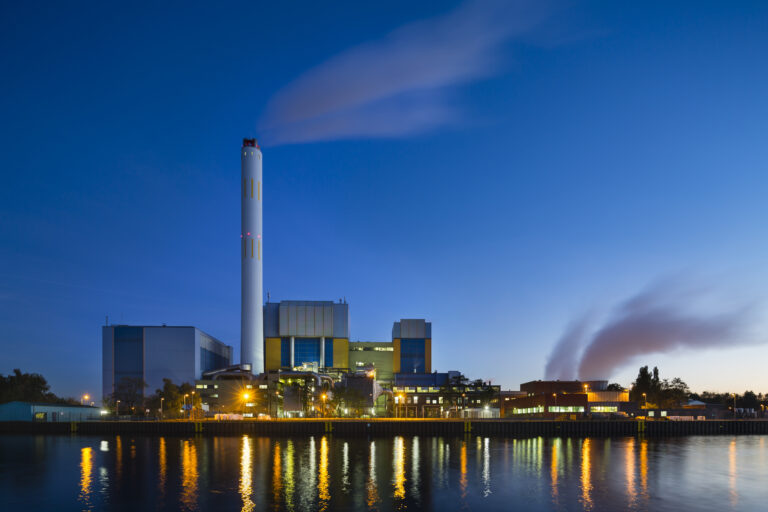
Slagging in waste-to-energy boilers directly reduces plant availability by restricting heat transfer, accelerating corrosion and triggering unplanned shutdowns that can take a facility offline for days or weeks at a time. The furnace alone accounts for roughly 50% of total heat transfer in a boiler, which means deposit build-up in that zone has an outsized impact on overall steam generation and output. The sections below answer the most common technical questions about boiler slagging in WtE plants, from what causes it to how on-load cleaning systems help manage it.
What causes slagging to build up in waste-to-energy boilers?
Slagging in waste-to-energy boilers is caused by the combustion of heterogeneous municipal solid waste at high temperatures, which releases alkali metals, chlorine compounds and heavy metals that melt, condense and adhere to furnace walls and heat transfer surfaces. Because waste fuel composition varies constantly, the resulting deposits are inhomogeneous and unpredictable in their distribution.
Unlike coal or natural gas, municipal solid waste has no consistent calorific value or chemical composition. A single load may contain plastics, organic matter, metals and textiles in varying proportions. When this mixture burns, the flue gas carries a complex cocktail of compounds. Alkali chlorides, in particular, have low melting points and readily form sticky layers on membrane walls and superheater tubes. These layers then act as a trap for further particulate matter, causing deposits to grow progressively thicker.
High furnace temperatures compound the problem. At temperatures above the ash fusion point, molten particles impact the walls and solidify into hard, glassy slag. Variations in combustion intensity, which are common in WtE plants responding to fluctuating waste quality, create thermal cycling that alternately melts and re-solidifies these layers, making them increasingly difficult to remove.
The inhomogeneous nature of the deposits is a practical challenge for plant operators. Slagging does not build up evenly across all surfaces, so a cleaning approach based on fixed intervals rather than actual deposit conditions will inevitably leave some areas undertreated and others overcleaned.
How does slagging reduce heat transfer efficiency in boilers?
Slagging reduces heat transfer efficiency in boilers by forming an insulating layer on furnace walls and heat exchange surfaces. Slag and ash deposits have low thermal conductivity, which means heat that should pass through the tube walls into the working fluid is instead retained in the flue gas and lost. The thicker the deposit layer, the greater the reduction in heat absorption.
The furnace is the zone where this effect is most damaging. Because the furnace is responsible for approximately 50% of total boiler heat transfer, even a moderate layer of slag on the membrane walls can cause a measurable drop in steam output. The boiler must then compensate by burning more fuel to maintain the same steam parameters, which increases operating costs and CO2 emissions simultaneously.
Downstream of the furnace, deposits on superheater and reheater surfaces reduce the temperature of the steam reaching the turbine. This lowers the thermodynamic efficiency of the entire power cycle. In WtE plants where electricity generation is a primary revenue stream, this efficiency loss translates directly into reduced income per tonne of waste processed.
Slagging also disrupts flue gas flow patterns. Large clinker formations can partially block gas passes, creating uneven flow distribution that further reduces heat transfer in some zones while increasing thermal stress in others. This uneven loading accelerates wear on tube surfaces and support structures.
Why does slagging lead to unplanned boiler shutdowns?
Slagging leads to unplanned boiler shutdowns primarily through two mechanisms: clinker falls and accelerated corrosion. When slag deposits grow large enough, they detach from furnace walls under their own weight and fall into the hopper area, causing physical damage to grate systems and ash handling equipment. Separately, the chemical environment created by deposits drives corrosion that can breach tube walls and force emergency stops.
Clinker falls and mechanical damage
As slag accumulates on furnace walls, it forms increasingly heavy masses. Once a clinker formation reaches a critical size, it breaks away and falls. The impact on the hopper, grate or bottom ash system can be severe enough to cause immediate mechanical damage requiring repair before the plant can restart. Even where the damage is not catastrophic, the debris must be cleared before normal operation can resume, adding hours or days of downtime.
Corrosion under deposits
Deposits create a chemically aggressive environment at the tube surface. Chlorine compounds trapped beneath slag layers react with the metal at elevated temperatures, driving high-temperature chlorine corrosion at rates far exceeding what the tube material was designed to withstand. Sulfur compounds contribute further through sulfidation. Over time, this corrosion thins tube walls to the point of failure. A tube leak in a pressurised boiler requires an immediate shutdown, and the repair process, including cooling, inspection, welding and recommissioning, typically takes several days at a minimum.
Both failure modes share a common root: deposits that were not removed before they reached a damaging size. This is why the timing and effectiveness of cleaning interventions matter so much to WtE plant availability.
How much downtime can slagging realistically cause per year?
The amount of downtime attributable to slagging in a waste-to-energy plant varies significantly depending on waste composition, boiler design and the cleaning strategy in place, but unplanned outages caused by clinker falls, tube corrosion or blocked gas passes can realistically account for several days to several weeks of lost production per year in plants without effective on-load cleaning.
It is difficult to give a single figure because the variables are numerous. A plant processing relatively homogeneous industrial waste with a stable calorific value will experience less aggressive slagging than one handling mixed municipal waste with high chlorine content. Boiler geometry also matters: tight superheater tube spacing gives deposits less room to grow before they begin bridging and blocking gas passes.
What is consistent across WtE operations is that unplanned downtime is disproportionately costly compared to planned maintenance. A scheduled outage allows operators to prepare, coordinate resources and minimise lost revenue. An emergency shutdown triggered by a clinker fall or tube failure carries additional costs: emergency repair rates, waste diversion fees if incoming waste cannot be accepted and potential contractual penalties for missed energy delivery commitments.
Plants that operate without demand-driven cleaning systems tend to accumulate deposits between fixed cleaning intervals, increasing the risk of a sudden, large-scale detachment event. Plants with continuous or condition-based cleaning maintain deposits at lower levels, reducing both the frequency and severity of unplanned events.
What’s the difference between slagging and fouling in WtE boilers?
Slagging and fouling are both forms of deposit build-up in boilers, but they occur in different zones and involve different physical processes. Slagging refers to molten or partially molten ash deposits that form in high-temperature zones such as the furnace, where temperatures exceed the ash fusion point. Fouling refers to the accumulation of ash and condensed vapour deposits in lower-temperature convective zones such as superheaters, reheaters and economisers.
The distinction matters practically because the two deposit types have different physical properties and respond to different cleaning approaches. Slag deposits are typically hard, dense and glassy. They bond strongly to tube surfaces and require significant mechanical or hydraulic force to remove. Fouling deposits in convective passes tend to be softer and more porous, though they can sinter and harden over time if left untreated.
In WtE boilers, the boundary between slagging and fouling zones is not always sharp. The high chlorine content of municipal waste flue gas means that sticky alkali chloride deposits can form at temperatures lower than would be expected in a coal-fired boiler, extending the slagging zone further into what would conventionally be considered the fouling region. This is one reason why WtE boilers present more complex deposit management challenges than conventional power plant boilers.
From a plant availability perspective, slagging in the furnace tends to produce the most dramatic failure events, such as large clinker falls, while fouling in convective passes tends to cause a slower, progressive decline in efficiency that eventually forces a planned or unplanned outage for manual cleaning.
How can on-load cleaning systems reduce slagging-related downtime?
On-load cleaning systems reduce slagging-related downtime by removing deposits continuously during normal boiler operation, preventing them from reaching the size and hardness at which they cause mechanical damage or force a shutdown. By keeping deposit levels controlled at all times, these systems eliminate the accumulation cycles that lead to clinker falls and corrosion-driven tube failures.
The core advantage of on-load cleaning is that it does not require the boiler to stop. Conventional cleaning relies on scheduled outages during which operators manually remove deposits that have built up over weeks or months. On-load systems work while the plant is generating, using water, steam or mechanical impulse to dislodge deposits before they consolidate into hard slag.
Different zones of the boiler require different cleaning approaches. In the furnace, water-based systems are particularly effective against heavy slagging because the thermal shock of water contact fractures and dislodges even hard deposits. In convective passes, retractable sootblowers using steam or air address the softer fouling deposits that accumulate on superheater and economiser surfaces. Rapping systems provide an alternative for heating surfaces where loose deposits respond well to mechanical impulse rather than a fluid cleaning medium.
Demand-driven cleaning takes this further by linking cleaning activity to actual deposit conditions rather than fixed time intervals. Sensors and diagnostic systems monitor heat transfer performance across boiler zones and trigger cleaning only where and when it is needed. This approach avoids both under-cleaning, which allows deposits to grow, and over-cleaning, which wastes cleaning medium and causes unnecessary thermal stress on tube surfaces. The result is more stable boiler performance, lower maintenance costs and measurably better plant availability over the course of a year.
How Clyde Bergemann supports WtE plant availability
We have been developing on-load boiler cleaning solutions for more than 60 years, and WtE plants represent one of our most demanding application environments. Our Clyde Bergemann boiler efficiency systems are designed specifically to address the deposit challenges described throughout this article, from heavy furnace slagging to progressive fouling in convective passes.
- Furnace cleaning with water-based systems: Our SMART Cannon and Shower-Clean System (SMART SCS) use water as the cleaning medium to remove heavy slagging from furnace walls and empty passes without requiring steam or compressed air, which reduces auxiliary consumption and maintenance costs.
- Demand-driven cleaning with SMART Clean: We apply condition-based cleaning logic that responds to actual deposit build-up rather than fixed schedules, keeping deposits controlled across varying waste compositions and fuel qualities.
- Convective pass solutions: Retractable and part-retractable sootblowers address fouling in superheater, reheater and economiser zones, maintaining heat transfer efficiency across the full boiler.
- Rapping systems: For facilities with varying fuels and loose deposits, our PKL rapping system cleans heating surfaces and economisers without a fluid cleaning medium.
- Spare parts and service support: We provide spare parts, maintenance surveys and operator training tailored to individual plant requirements, supporting long-term system reliability.
If you are dealing with recurring slagging problems or want to evaluate whether your current cleaning setup is limiting your plant availability, get in touch and we can discuss what a more effective approach would look like for your specific boiler configuration.
Related Articles
- What causes boiler fouling in waste-to-energy plants?
- Understanding heat transfer degradation and what soot deposits actually cost
- How modern on-load cleaning systems reduce maintenance costs over time
- How regular boiler cleaning reduces unplanned shutdowns
- How often should industrial boiler tubes be cleaned?